(This is a project, the goal of which I didn’t grasp until I had written this phase, which uses the journalist George Plimpton symbolically as a truth seeker, or truth teller.
Truth tellers are currently under attack in this political era which is charged with highly volatile propaganda.
Plimpton is our Orwell. We should know about him. And he ought to be reclaimed and remembered.
Authenticity, I realize- that is the essay I should have written, as a counterforce to the incessant untruth we are subjected to daily.
***
A note about performance.
I do like speaking these little texts aloud. They speak to me.
In a sense this is a little performance piece. It’s cryptic, I know. Its thought is not fixed, and that is a good thing.
I know, Plimpton doesn’t get to say anything here. He is just in existence.
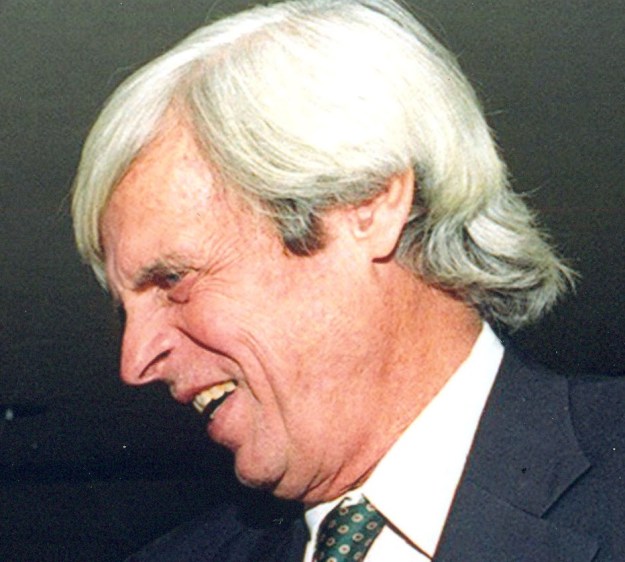
(photo by Nancy Wong, via Wiki)
***
The Day I Met George Plimpton:
-Artificial Intelligence and Real. The Journalists of Participation
1. The Machines are Listening
(George Plimpton was a prominent journalist, a founder of the New Journalism, participatory journalism, and founding editor of Paris Review. I met him briefly in 1993 when I worked at a little used bookstore in San Francisco. We exchanged a few sentences.)
Disclaimer:
In this era of contentious dialogue, I wish to assure others that I write to you, but not at you, and my assertions are mainly addressed to myself. When I say “you” I really mean “me” and vice versa, with the exception that when I say “me” I also mean “me”.
I promise to not presume anything whatsoever about who you are, or what you know or do not know, or how you should think.
***
End of an Age of Reason:
When a person from a Totalitarian State comes to the US and points out that the indicators for that to come into being are here, that’s a problem.
Here she is, listen:
-“This is Putin’s tactic to silence media: first, compromat. Next, journalists start falling out of the windows or they are hit by bricks on the back of their heads in the street. Foreign journalists are not allowed to enter (happening in the US today.) This is what the hybrid war is: the war of narratives. Journalists and writers tell stories. Politics are all about stories. Independent media tells stories unwanted by tyrants. Tyrants kill stories and story tellers. Before our narrative is flipped, protest. We must gain sanity and dignity back before it is too late.”
-author, Zarina Zabrisky
***
Now, what was I saying about George Plimpton, an originator of a school of journalism, and a link to the inner lives of writers?
And what, if anything, does this have to do with “fake news”? And journalists being the “Enemy of the People”?
I have to admit something first, about reading.
I do a reading-like activity, that is, I read, I walk away. I re-read, I think about what I read. then, I’m forgetful, I have to recall what the writer was saying, all the connections she’s curated in the text, so I start over again with a meditation on the implications the world of its prose.
Then, before long, I’m on page one hundred. I’m already fulfilled and stimulated. I’ve spent quality time. I’ll get there, eventually, slowly slowly slowly.
Occasionally I read a book multiple times.
And often I don’t get past p. 39.
It’s sad but it’s also ok.
So you can pretty much take anything I write with a grain of salt. I’m not knowledgeable.
I was recently yelled at online. Can’t you read?
Umm.
It’s ok.
I say “it’s ok” often to assure you, (and by you I mean me) that the process, the living of the little life of a thought process has a way of its own, and if allowed to move, it will be. It’s not about expectations or goals.
I’m a child of the sixties: You do your thing and I’ll do mine.
***
This kind of reading which I’m describing changes the body of your thinking, I feel.
How could thoughts have a body?
They have form. That’s all I’m saying. And, if you’re alive, they have movement. Your thought can move.
I know it sounds weird but just try moving the arms of your thought. See what you can reach with the hands of your thought process all the way to your fingertips.
You can reach a very long way. For example, my thoughts reach all the way to Yosemite right now. Look, Bridal Veil Falls!
That’s right. Now reach down to the toes of your thoughts. There’s some crusty old opinions down there. I’m just speaking for myself now. Yikes.
Some scholars run thought/marathons. Some practice walking-thought meditations. They are professionals, though.
They challenge their thought. Their thought fires back. They and their thought talk quietly, weighing, considering, figuring.
Some thoughts are in the boxing ring. Some run like mad down a football field. Oh no, wrong direction!
It’s fine.
The idea is to not remain fixed. Rigidity is a problem. It can be reversed- until it’s too late. We won’t know if it’s too late -until it actually IS too late.
***
A sign of rigidity is the feeling that your most worn-out thought is precious. Your thought has turned to stone.
Your thought is so stonelike that a fine artist like Vija Celmans could take that thought and make of it a brass mold, as she did with stones she found on the beach, and repaint every feature of it so it looks exactly like the original thought and display it in a museum and then laugh and admit, as she did on a spontaneous appraisal of one of her painted simile stones, that “it looks like a turd!” (In a recent New Yorker profile of the artist.)
https://www.newyorker.com/magazine/2019/09/02/vija-celmins-surface-matters
And sometimes you wonder that people don’t understand your thought, but they really just don’t want to break the news to you that your thought is dead. Look, they poke it with a stick.
See? Nothing. It ain’t moving.
It’s ok.
The painted stones and skies and waves of a Vija Celmans are amazing- but you know what I’m saying. Her stones report her experience in a unique way that involves what is. And that involves truthfulness.
…So, that day I met George Plimpton-
Oh, wait. I’ll finish this later. I have to go and serve my community. For pay. I’m not Mother Teresa.
jk
9/9/19
Continuing: I forgot to bring the robots!
The Day I Met George Plimpton: Artificial Intelligence -and the Human Kind part 2
Mr Plimpton came into our little unruly bookstore one clear Saturday night, with his lovely wife on his arm. Dapper couple, looked like they had just stepped off of a yacht. Beaming smiling, they looked around and George Plimpton said
“This is marvelous!”
2. Canticles of Computerware
Who is authentic, anymore?
Here in San Francisco, Andy Warhol was at the museum, not far from Vija Celmans.
I say Andy, because that’s what we have of Andy. His work is him, I feel.
We live in his Age. His imagery has leveraged stock, both financially and politically.
Poster screen art, huge. Larger than life, superseding everyday life in every way an image of limited dimension may.
The familiar, blown up, large. An engineering feat, everything looking exactly like everything. Now live and in color. So familiar I took no selfie.
Seen it a hundred times.
We live in an age of facsimile. In fact, last week I got in an argument with one. My fault. I strayed from the path of righteousness, and ended up talking to a troll.
Note to self: stay out of comment threads, dummy. They’ll eat you alive, insult your mother, trash your town -all from the comfort of a system of tubes and towers.
A sociopathic technology- That’s an amazing idea.
But back to Andy.
There’s Elvis. There, a revolver. And Marilyn. And listen, Velvet Underground. And there, Andy himself, with that holding-my breath -as-long -I can-look of his.
(Hey Andy, the robots are coming. They’re already here, the bots and algorithms. They’re facsimilizing people now.-soon everyone will BE one for 15 minutes.)
-Oh, and now, here, Donald.
Andy Warhol Talks about Donald Trump throughout the Mid-1980s
Donald, with his multicolored hair, always a new dye, sometimes hair the color of straw, yellow over pink, white, all fading into neutral nothingness; the agony of the blank wall and a forgotten frame.
Stencil psychedelic hair, a troubling wave of a combover, the effect of disharmony, of tints clashing on a color wheel. What is meant to be a wave of optimism is really an advertising for detergent.
Donald is so Andy! Andy as adjective.
A walking silkscreen cut- out collage of presidential detritus over time, including an authentic flag pin, and a lot of spilled ink. Thumbs up.
Hunter S Thompson used to cry out at the pathology of power in American society.
“How long, Lord?” the American Jeremiah, crying in the wilderness.
A mass of blue opaque, the ubiquitous suit of a US President: the ever- present red tie, bled-through silkscreen at the edges, red and blue of Donald Trump oddly reminiscent of the flag pants of Jerry Garcia.
And now, thanks to a 3D printer and a ton of cable television social media, he’s pretty much everywhere.
Endless repetition. Slight variation.
He’s the most famous man the world!
Andy Andy Andy! What have you done?
(Could a machine do this?)
***
I work with a man from Tibet. He says Trump imagery reminds him of gigantic Mao propaganda.
When a person from a Totalitarian State sees the signs here, it’s a problem.
Journalists are under attack, writers.
Formerly writers like Plimpton, Joan Didion, Hunter S Thompson, Warren Hinckle flipped the script.
They left a trail: of authenticity.
https://www.theparisreview.org/interviews
***
What is authenticity?
“…This is marvelous!”
Mr Plimpton, gazing about in approval at a little community space of books and filled with music.
“What is that marvelous music? Isn’t that wonderful, dear?” he said to his wife, also smiling.
Oh. Bluegrass music. That’s so funny to me now.
“We will have to come back.”
The many authors he brought to public attention are right over his shoulder on the shelves there. The many interviews in Paris review, authors explaining, explicating the craft. Back to Kerouac, Pound, Gertrude Stein. Mr Plimpton reaches back as an influence and editor to the time of Joyce and Fitzgerald, practically.
“Darling we’ll have to come back.”
Before the bookstore closes, and the book burnings begin, I savor this moment.
jk
9/10
A little Epilogue to my piece about Plimpton.
Trump called journalists “the fake news”. What is authenticity? Plimpton, on participatory journalism.
With Hemingway in Cuba and Bernstein in NY. And Edie and Andy Warhol too.
 jameskoehnsf's Blog