Redwood Rhapsody
It’s a gorgeous September morning. Fall is imminent, with all its unexpected drama of falling leaves and explosions of color. In Northern California, the best weather can be had in mid-September, in the shifting Indian Summer that brings warm sunshine, heat and perfect evenings. You’re panning for gold and it comes in September.
The vacation is over for most Americans, so the tourism thins in mid-September. I go north up Highway 101 with a private, sneaky kind of pleasure, knowing I’ll have the gold hills, the mottled forest drive, the enormous vistas mostly to myself. I stake my claim and tell no one. I can stay in small towns like Ukiah or Willets if I get tired of driving, and find a cool motel room and kick back. And in the morning, I’ll go to the redwoods.
If one drives north from San Francisco, one can visit the redwoods, and this is the best time of year. They are our crowning achievement, though we had nothing to do with their creation. They belong to us, and they fill us with pride of place and wonder. There is nothing like them on earth. These are our redwoods, called coast redwood, sequoia sempervirens: forever living.
They stand like towers of austere beauty all along the north coast, though just a bit inland, where they can gather enough calm and fog to make them happy for a thousand years or two.
A thousand years?- More. Fifty million years would comprise the timeline of the former world in which these giants dwelled supreme, dominating the entire continent. The redwoods were everywhere in the primeval landscape- They ruled in peace.
Impervious to fire, immune to disease, knowing no significant threat whatsoever, they sprouted upward, utopian, three hundred feet high, creating a canopy that filtered the sun into natural groves of shade and darkness, making them the perfect friend of the tiniest forest dwellers.
Spiders spin delicate webs in the corrugated bark; bats nest within their trunk hollows, while dinosaurs walked by in ages past. My personal favorite inhabitant is the big raven, whose scratchy old caw echoes throughout the place, a sound like rubbing an old gourd with a stick- a sound I know was heard just the same eons ago. The same peace, the same place.
The raven and the redwood seem to have a special rapport, its caw echoes so evocatively, so mysteriously, in the groves. It echoes around the secluded place and is the sound of its memory. I know this raven knows all the stories, and still reports the latest news in the grove.
If you go to the redwoods, to a place like Richardson Grove, you may as well just bring yourself and leave your camera behind. It will only distract you.
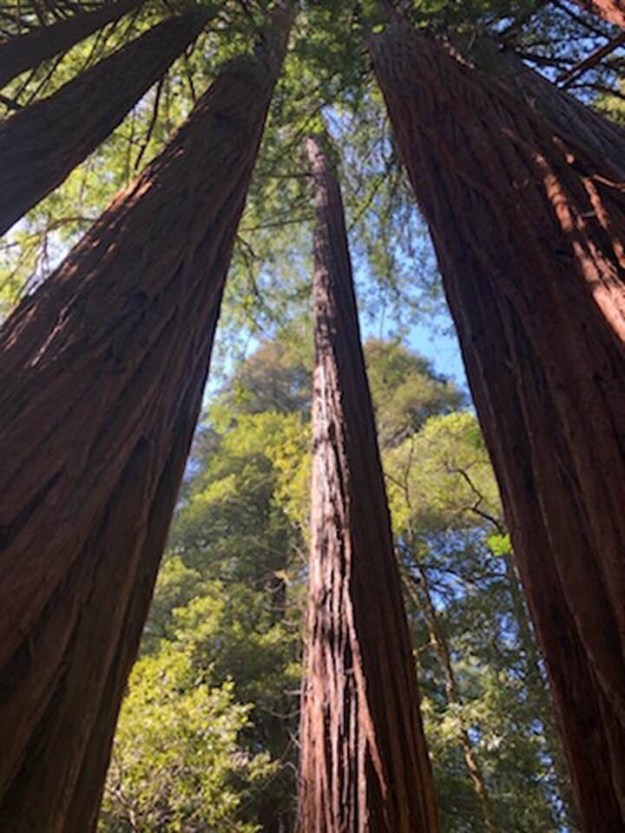
Here the trees stand like staves, in giant ranks all around you, so tall you can’t get them in a picture. And the sun bathes the place in shafts of quiet and light. It can’t be photographed. You’ll just have to memorize it. Scores of two thousand year old trees, their eminence, their peace, all around you on a September morning. Try to allow it all to effect your psyche, so that later you may remember, and so you can daydream about it when you need to.
Funny, that among these trees you find yourself face to face with their feet, so you gaze into the patterns of bark. We’re small, they’re tall. That’s just the way it is. The redwood bark has a sculpted quality, as though loving hands passed down, leaving furrows with each fingerprint, pleased with its finality.
I find myself looking for my favorite bark. Some are golden, some a lighter gray, like ash, and these look museum quality to me. There are primeval, dark trees too, with blackened bark from fires a generation ago, or a century; from the stunted trunk a giant candelabra formation rises like a wooden torch held aloft- a new tree or two, or more, held suspended by the former trunk of the old, the structure of which endures to support the whole.
Some bark looks virile, I must admit. And some are haggard. I scout the oldest trees, which have a stone-like austerity.
Once, after riding the old logging Skunk Train through the forest, I asked a resident what she liked best about the redwoods, and her answer has to do with the bark. She said the bark of redwood has the powdery red particles, for which the redwood is named, and when rains come, all that red washes down the streets- but reflects gold when the sun breaks through. “The streets turn to gold,” she said. Good answer, I thought.
Standing at the base of the greatest tree ever, the foot of which is so like an elephant’s- you just can’t believe it: it’s living, and it stands, and, massive, thirty feet around, in diameter, flat at ground level, it grips the earth with its very treelike knuckles, but beneath the surface the root system is very shallow. The tree just begins, shoots straight up as high as you can see, without pretense.
It is an irony that the great redwood is most vulnerable at its base. Human footsteps too near may impact the ground around the roots, compacting the soil, making it hard for the roots to breathe, We unwittingly harm these trees when we draw near them. I know I harm these trees. They are delicate, sensitive. I am certain they know not only my car exhaust, but my human breath, and must somehow be aware of my presence, perhaps even of my thoughts.
But look up, traveler. That’s what we are here for. The whole deal with the giant redwoods is their enormous height. You stand at the foot and look up in vain to find the crown, which is lost among the foliage, it’s needley green complexity ‘way up there, four hundred feet above. Up, up, up- well over a football field straight up, as one writer points out to the earthbound among us.
And beyond is the bright blue sky, and there the topmost branch, in an aura of golden green, glories in triumph, meeting the sun, lording over the landscape, greeting the elements of the natural world from an absolutely unique outpost. You go there. You imagine the prospect and you go, imaginatively. This gentle giant of a tree beckons you to think about the view from up there. And a whole chorus of trees equally tall stands all around you. Every treetop crowns the atmosphere, as it has for centuries and centuries, going back in time.
Brave loggers felled the big trees. And sometimes nature brought them down, through washouts. But glacial epochs had much to do with the near extinction of coast redwood everywhere but here. Here on this September morning, where I stand among them.
In our time, we use the fallen as a timeline, counting the tree trunk’s rings back through human history. Particularly famous attractions we note with a pin: the date of the Declaration of Independence (a living thing happening!) – there is a ring for that; back to Magna Charta,a deeper ring; the Roman Empire; the birth of Jesus, still more concentric rings, into the tree’s core. The tree’s rings register even earlier events- In terms of the chainsaw, it is an unwilling disclosure on the part of the tree, nonetheless translated to laptop, and now to thee.
The tree rings give one an idea of just what California was up to at the time, growing this very tree, among other things. When Romans were building and losing their distant empire, there was quiet in this grove, when this particular tree was young.
Once in the redwoods up in this place called Prairie Creek, I saw a little herd of elk standing in the gravelly riverbed. Fascinated, I went back to the spot at dusk and watched the elk rise up like spirits from their resting place, awaken into movement, and slowly, methodically, gather to move into the foggy upper reaches of the redwood forest. In the daylight I was somewhat shocked, for they were looking back at me: I was the object, not them. But here I stood unnoticed at dusk by the riverside in the gloom.
And then the elk gave forth an awe- inspiring bugle call as though through those long ancient mountain horns of Tibet, and it screeched out it’s shrill breath and echoed throughout the region. I felt it in the core of myself, in the ground of my being, and it scared me, the sound was so very primeval.
This language predates Man. And the call then was returned from the fastness of the hills, sonorous, shrill, this crazy elk call of nightfall.
And the elk will go in peace to some unknown place and observe Night as it has existed for eons. I’d heard something that has to do with the beginnings of what I think of as Time, and the fallen redwood tells of similar things.
Once, near the Avenue of the Giants, I took a path away from the sunlit trail and found myself in a really creepy old growth of trees. Ferns everywhere, black old patriarchal/ matriarchal redwood trees, thousands of years old, frowning down at me; old hunks of forest impenetrable all about, and darkness and crows squawking, and I realized I was getting too close to the edge of my Time Period. I wasn’t far from the path, but this was plenty primeval for me. I think of this place only when I am safe in bed, under warm covers.
You can see ghost redwoods, too. The children of the old tree stand in a circle, for they grew as sprouts from its center. Sometimes the middle tree dies, finally, after many centuries, and may fall, and over time be swept aside, decay, leaving the empty space around which the young trees stand, now grown and towering above you in the grove.
The position of giant trees, which stand around the central empty space, infers the history going back to a time one can’t see. Perhaps a fallen trunk is a thousand years old: it supports life today, and promotes life as it decays. That is nothing new. But once the tree was a mere sapling.
I brought such a coast redwood sapling back with me. It was one inch tall. Perhaps it too will live to be two thousand years old. If it grows we will plant it and that will be a memory tree to someone who lived and is now gone. As I write this, I wonder how ancient that very thought is, that the spirit of someone you lost would live on in an eternal tree like a redwood.
Who knows, there might be an ancient piece of redwood in your deck, or more likely shingles, furniture, sequoia sempervirens, part of your house. It was plentiful at one time. Seemed endless, that time.
There is the sunlit majesty, and there is the darkest edge at which one ponders the beginnings of Man. And there is daily life in September in the dawn of a century. The dawn redwood knows all of this, I’m certain.
So drive back home through the Avenue of the Giants, seemingly endless regiments of three hundred foot trees passing by. Do the math on their cumulative age and then give up: there are too many years involved in forest time.
And when I asked the redwoods about time they replied, “What time? There is no such thing. How old am I? I am new today, though I stand for 1500 years, I am new today!”
I drive, piano music on in my comfortable rental car, and soon I’ll be out of this ancient place and back in San Francisco, having a latte.
One night I had a dream. I loved the redwoods so much I dreamt the perfect redwood tree! It stood tall against the sky alone, enormously tall – incredible. It was pure and bright, the bark slightly luminous, made of dream stuff, and the redwood stood out against the brilliant night sky of my dream. And by the tree stood a little house. Secure. And by the house and the tall redwood tree, a familiar path. Familiar. And that was all. I woke up overjoyed, for I had found it. The eternal tree, sequoia sempervirens, ever-living, that I could go to at any time. It was in my mind, my psyche. It’s there forever. I am right there now. And you can go there too.
james koehneke
San Francisco
September 10, 2003 (Written as a kind of mental postcard to Californians who died on Flight 93, at Shanksville, Pennsylvania, on Sept 11, 2001.)
 jameskoehnsf's Blog