-A Monterey Discovery part two
(My own introduction to the great California poet Jeffers was through a beautiful reissue of “The Double Ax”.
These are poems of tragic grandeur and dissent, evolved from the elements of the California landscape in isolation.
Magnetic, shocking, violent, the great poems are texts of opposition to modern war; they seek sanity in the detachment of the remote ancient cliffs and surf. In a search for beginnings we find ourselves on the road to Big Sur where a couple of artists dropped out of modern life to create art that is timeless.)
***
A Visit to Jeffers’ Tor House and Big Sur; CA Rough Drafts
It was the classical education, perfect for a poet, and an homage to the literary father.
But it was the wife who was the driving force, the insistent muse, the artist.
One cannot visit Tor House without wondering about- and at- Una Jeffers.
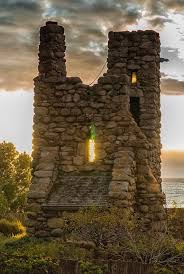
Tor House with its tower by the sea is made of stone rolled by Robinson Jeffers by hand up the beaches of Carmel, but the effect is feminine. They achieved a balance here. The stone house was built by a mason with the help of the poet, but the overlooking tower the Jeffers accomplished themselves. The stone house with its yard, the miniature estate on a town lot by the sea, makes one think of fairy tales, Jungian psychology, and the ancient cauldron, the mortal and pestle, of medieval Europe. The folklore was the rage of Una Jeffers, her pursuit of the poetry of history. Tor House is a Tolkien- looking affair, and would look handsome with a roof of thatch, if that were practical.
The nearness of the sea, the constant damp made me sniff the mold, and I worried about the collection of first editions of Jeffers poetry kept in a locked bookcase in a pantry. I said nothing, but longed to examine them, the volumes of the nineteen-twenties and thirties themselves were works of art, with Art Deco lettering on their spines, and a Rockwell Kent sort of feel to the presentation. A bit musty in the stone house, heavy with wood, panelled and dark, with floorboards that creaked when the poet, in a tiny upstairs loft directly above the living room, paced- meaning his writing was done for the day.
The place is somewhat shiplike of course, tiny as a rather luxurious cabin would be, with window to the Pacific, in the back yard. The Pacific Ocean IS the back yard. But luxury is not the word for this rustic haunt of Una’s.
It’s a stone house inspired by Una Jeffers’ fascination of the Irish towers of centuries ago. She collected impressions of these in trips to Ireland, and must have dragged the poet from one to the other.
From tower to tower they went across Ireland, and we tourists to Jeffers’ Tor House smiled at Una’s faded map, folded and framed on a wall in the living room, with its countless dots scattered about the country, marking each to’r they visited, at her insistence. There are scores of them.
This is a remote land, the California coast, and it must have satisfied their euro-centric desires for castellated Scotland or Ireland-
The plan of the newlyweds delayed, a journey prevented by the First World War and the birth of their first child. Fate brought them instead to the Big Sur region, at the relatively safe distance of Carmel, and with proximity to an actual town, that is Monterey.
They now had a house with stone tower by the sea and devoted themselves to artistic pursuits.
At night the Jeffers read aloud, and this is utterly believable, that they would drink wine, light candles in the stone house without electricity, and read old novels and folktales nightly.
It makes sense that Jeffers would limit the wine to one glass- a gigantic snifter- as an aid to poetry, and knock it over by dawn, momentarily waking the household. I’m grateful to know this salutary glimpse of the private lives of poets, and find it not ironic, but intimate.
Una collected strange music, some from the old mission, and played piano and organ, and much of what she collected one could classify as primitive, that is, prime- ative: that which comes first.
They were night people, obviously.
The life of the Jeffers was well conceived, and this is a credit to Una. The house by the sea, the need for solitude, the conception of art as how one lives each day, that has to be Una.
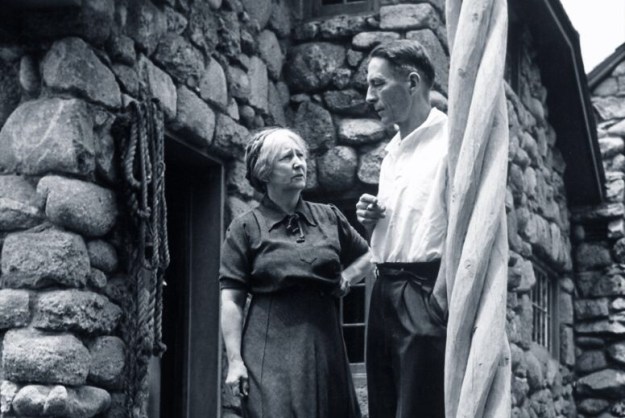
One gets the impression that the Poet was actually the quiet one. It is said that Jeffers rarely spoke, but listened to guests at their little gatherings at Tor House, and was not quick to laugh. But Una brought people in, and there was a bit of artistic hobnobbing now and then, which documents the Jeffers’ lives in Carmel.
Una was the story-gatherer and folklorist. She stopped the neighbors, those remote denizens of the Big Sur coast, that broken shoreline towering over cliffs, which they first saw in rainstorms and fog as enchanted, forbidding, downright spooky and beautiful…
Ina brought the stories out. Who lived in that shack overlooking the canyon? What murders, ghost stories, native folklore, in the local gossip?
Their travels in the near region were horse-drawn, and wheels of the surrey got stuck in the streetcar tracks on the road to Monterey. According to best friend and biographer, Edith Greenan, the source of many of these insights and intimacies, Una drove. Her biographer found the rough carriage ride terrifying, but tells us
“Una was unconcerned. She chattered away, pointing out fascinating old adobe houses. There was one little streetcar track in Monterey. My fear was great that Una would get the wheels of the buggy caught in the track. I no sooner thought of this than it happened. Undisturbed, Una sat up straighter than ever, completely disregarding the fact that she had done anything awkward. She refused to admit by the turn of a hair that a mild catastrophe had occurred. Miraculously she extricated us. The wrenched wheel revolved like a disgruntled egg beater, making a hideous sound. Of course people turned and laughed at our ridiculous progress up the street. Robin sat beside Una, not saying a word. He didn’t mention the accident and I didn’t dare to.”
Edith writes, “As we drove up the steep grade to Carmel, Una stopped to let the horses rest and to point out the Monterey Bay behind us- a perfect blue crescent, one of the most beautiful bays in the world.”
If the Jeffers had a rough ride to Monterey, then certainly the road to Big Sur must have been somewhat harrowing in the early days of the last century- I found it so on the modern highway as I negotiated hairpin turns in the fog, a thousand feet below, the crashing surf, and oncoming traffic appearing out of nowhere in a steady stream around the bend on this rise of Highway 1 as it heads into a cloud of invisibility for a few moments and then reappears out of the jagged edge of fog.
The cliff edge is sheer and rises above us at a near-vertical, and plunges to the foot of the Pacific at roughly the same angle. If the angles of the cliff were the hands of a clock, the hour hand would be pointing at two, the minute hand at 40 minutes past the hour, meaning it’s time for massive falling rocks from ‘way above. There is nothing but air between them and me, in a rolling, tumbling plunge downward.
In the nineteen-teens, the Jeffers went along this way by horse and buggy, but eventually the old country road snakes inland and ever upward, for no bridge spanned the seaside canyons, and a modern road was still decades away. Even looking at a map of the old road in my guidebook makes me queasy. It isn’t paved, and the guidebooks give stern warnings about four-wheel drive vehicles and extreme caution.
They drove the treacherous coast in a rainstorm and loved it. The haunting beauty of the coast does make one cling to life a bit more tightly , if not with the stern passion of poets.
On their first trip Una began to collect impressions which appear in the Jeffers poems. The folklore of Big Sur she found steeped in tragedy, and matched her mood for the morose old balladry of death and betrayal. The locals must have fed her stories, some true, about the legends of the place, and if its earliest inhabitants.
The balladry of the Elizabethans, with its shocking action, violence, and trenchant ironies, which push hard against a modern idea of sanity, fits with the remote setting of Big Sur as the world modernized and prepared for World War One. The Jeffers found their life on the coast to be a statement on the politics of the times, as well as a source of poetic inspiration. The dangerous world was the subject of lives, no matter where one lived.
The life on the edge, as we would call it today, has its dangers. The Jeffers revelled in the stories of Big Sur, the western feel: the woman killed by a stallion; of what happened at the abandoned shack at Point Sur; of small local epics of murder and mystery.
I sense they found in these, as much as lurid detail, the origins of Poetry itself. They read ancient poetry, and were experts- both were trained scholars, and must have pulled in such elements as the oldest traditions brought them by candlelight of an evening. They absorbed, as well, Earth knowledge of geology and sea coast, that provokes thoughts of beginnings, and man’s place in a scheme marked in terms of millions of years.
They were philosophically on a collision course with modernity and they knew it.
Jeffers rejected the precious and hopeless trends of modern poetry.
And he wrote poems in collaboration with the foggy, ancient coast which eventually were banned as unpatriotic. A vision of World War Two Jeffers saw as an incestuous tragedy of mankind’s longing for destruction. World leaders he saw as sellouts, as promoting unconscious drives, as placing the interests of men so far from their true place in nature. And all this is inevitable, this rapine. At the end, the rocks, the sea, and the old earth, inhabited by ancient birds, the vultures, the hawks, again ruling the roost. To be a poet wast to commune with rocks.
Robinson Jeffers’ verses. gripping and untranscendent, depict the sea coast, the planet’s horizon, its sun going down in a haze to the sea, which the Jeffers saw nightly through their bedroom window. They must have looked at each other and said, we’ll die here! With the sun going over our wall, and a minstrel in our gallery above our hearth. With our poems, and ancient keepsakes, our memories of dinner over the fire. With the spooky organ music of the old missions, and the oldest poetry safe in our cave by our various altars in the moonlight.
No doubt these two night creatures saw stars when the fog factory was down, and some nights along the coast of Carmel must have been bright with moonlight though drained of color. A somewhat dangerous walk in the dark by the ocean. One would stumble and laugh and catch one’s companion and chat and perhaps build a fire.
-Artists, they really are kind of crazy, aren’t they?
jk
6/20/ 2005
 jameskoehnsf's Blog
Pingback: California Beginnings | jameskoehnsf's Blog