California beginnings- there are so many. From a travel journal.
Monterey, an Evening Walk with- and without -history.
An artist makes a bold line; such is the course of this bay, inevitable and remarkable as Vizcaíno the explorer saw in the year 1602: a broad, perfect, convex curve of water which can only be appreciated from the vantage point of the Discovery Site. Indeed, it is beautiful from my park bench by the shore.
It’s a study of blue with many little boats that pose with masts leaning slightly, moored and balanced and poised throughout the bay. It’s a simple scene to behold, even the first explorers claimed it was just a circle of calm water, that you’ll know it when you see it. Just head from the rocky point east from the Pacific when you see the pine trees, Punto del Pinos, and look for the beach.
The 1602 explorers’ report is unabashed tourism, a veritable postcard to the King, wish you were here. The latter day visitors didn’t recognize it at first, and so sailed right by. Is this it? Is this Monterey? Are we there yet?
Of course I found it right away, though I nearly missed my exit, which in modern times means you’re stuck on Highway 68, driving in concentric circles to get back to your destiny/ destination.
But finally there it is, Monterey’s defining arch, Fisherman’s Wharf on a sunny first day of fall, on a beautiful afternoon. I parked at a little beach nearby called San Carlos and got out of the car to stretch. I found out later that I had rediscovered the discovery site, for here a ship first landed. Here California’s Spanish era begins, and so its (recorded) history begins.
Monterey has a significant role in the creation of California, though it is part of a continuum, of course, like a skipping stone on the calm surface of the bay before me. Not just the stone counts for something, but the ripples, too. It was the capital, the focal point of strategic access for the Euro-incursion led by Spain beginning in 1542.
I looked for beginnings, even for misleading ones, in books and historic sites, leaving to serendipity and to Rough Guides history’s latest revision.
From the wharf, I doubled back to scan the layout and stopped at a food mart to get some bearings. The food mart was right next door to the RLS house, where Robert Louis Stevenson stayed in the 1880’s near the center of old Monterey, just up the hill from the bay. I found a motel right there with a beautiful indoor pool and a hot tub, here in the year two thousand- something. Then I ventured out to find history.
I reconnoitered on a sunny afternoon, but took my walks by night. I had Monterey mostly to myself.
What Monterey isn’t: It’s what it is not, that got me thinking as I looked from my bench across the silver blue green grey bands of Monterey Bay, with its ribbons of kelp and dolphins that leap in astonishing unexpected arcs.
What it isn’t: It’s not a factory job or the crush of rush hour traffic. It’s not scurvy on a Spanish Death ship; not “gold fever” or endless prosperity, nor military prowess or religious fervor.
It’s not the hammering nails of the Southern Pacific, or the Big Four that ran California in its gilded age of growth. It’s not the good-natured merchant/nation builder Thomas Larkin with his house in the middle of town, nor the dusty-robed Father Serra who founded the old Mission, and whose bones rest in peace near the opulent golf course just over the hill.
All these left Monterey behind, it seems, a rather sleepy town of old adobes and modern low-storied structures. The notable absence of high rises makes it easy to imagine Monterey’s former incarnations one by one.
Here you walk a historic map, up a tilted mesa; up one walks a gentle slope, ten blocks to the 1790s church and its Presidio above town.
At the foot of the hill, the bay. You can hear the barking seals all over town, especially at night.
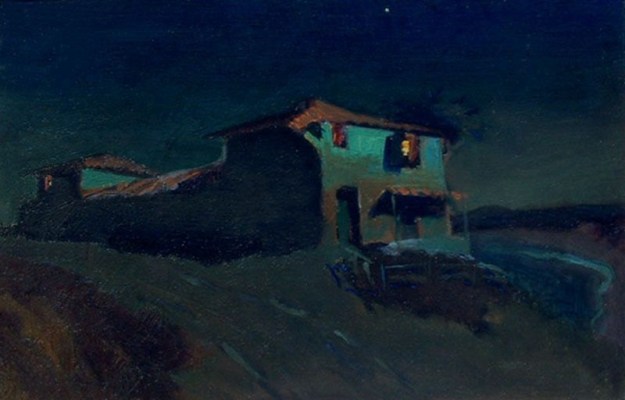
I saw most of the historic sites after sunset, encountering Monterey’s treasured old adobes, one by one. Each little site is illuminated by a low street lamp and marked by a cream-colored sign with the family name and approximate date.
It is an 1830s version of Monterey I walked through, pre-Gold Rush era, in its small square adobes with red tiled roofs, its relaxed layout, clustered on the Calle Principal.
Old Monterey was a community the language of which was Spanish, and it was destined to be the Califonios’ capital, even after the American takeover in 1847. Much of the old atmosphere is still accessible to the imagination today. A history walk with the tourist map I found remarkably rewarding.
John C Fremont, Willian Tecumseh Sherman, Robert Louis Stevenson, these are the presences one can picture ambling about. It’s not that long ago.
And a whole raft of painters: impressionists, plein air people, painters of romantic moonlit nocturnes. Painters -and writers.
One forgets what is real on an evening walk. Does the old barracks still exist? The old Whaling Station? If I knocked on Gen. Sherman’s little wood door in his little stone house of a warm evening, I was afraid he’d answer.
In modern times the downtown’s streets of shops culminate in a landscaped section of hotels near the wharf and the shore that was once “Cannery Row”.
My night walk takes me past the scattered adobes, their low walls of stone and mud-brick, back down to the old Customs House where US and Spanish and Mexican and indigenous cultures once converged- still do.
Here at Monterey, a potential antidote to scurvy and disease and despair of the long voyages of the Manila Galleons, the Spanish ships on transworld trading missions which had only begun 50 years before its inception, in the 1560s.
For fifty years the ships had taken the currents from Japan along the rugged California coast, haunted by the forbidding sight of Cape Mendocino: no place to land, to refuel to recover, on the long voyage to established ports in Mexico. These were commercial ventures, not the kingly missions of the Church- though the Pope, in a political quid pro quo, blessed the venture of Spain and Portugal, starting the first gold rush to the New World.
Forces in motion? Not here at night with the barking harbor seals and the marauding raccoons around the stilts of the wharf over dark water.
This is a scene of stasis.
Next to me, on the next park bench over, a woman toyed with her cell phone which emitted beeps and fanfares, while I looked straight ahead, thinking of history, looking at the shimmering water and kelp.
And when I get up, I can walk along Lighthouse Avenue in the moonlight, retracing the route to the sea.
 jameskoehnsf's Blog