This Machine Kills Fascists. This family brings Americans together.
Woodstock was an August event.
-Circles and Arrows and a Paragraph on the Back About Arlo Guthrie (2006)
This involves stories about other people, which I hesitate to write, since the stories are their stories, they happened to them, not me. But they aren’t going to tell them, and they had an effect on my Arlo experience last Sunday afternoon, so I’ll tell them in a general and inaccurate way.
Of course, it all starts with Woody Guthrie, the Father. Not only the father of Arlo, but of his brother Joad, who rode with us as we practically hydroplaned through a driving rain, to Marin Civic Center.
I met Joad many years ago- I think that is the correct spelling; he was named after the character in the Steinbeck novel, Grapes of Wrath, as a tribute to an era when Woody Guthrie travelled the country with a guitar, singing what Arlo and his sister count as the 3,500 songs he wrote, and which guitar he played them on had pasted or painted on its battered body the message “This Machine Kills Fascists”.
That the message “This Machine Kills Fascists” is one that might get the attention of the carnivorous and ambiguous and ever-present secret government surveillance of email and wire-tapping to which President George W Bush admitted last month, is an irony of history to which Arlo himself alluded in his performance, especially if an email keyword search re-scrambled the sentence, which is likely.
Yes, we picked up Joad in the East Bay, and drove out to Marin. I had met Joad Son of Woody in the eighties, at our bookstore. He lived in Bernal at the time, according to Marlene, who was driving us to see Arlo.
He walked in one day, Joad that is, back in 1985, and I had to catch my breath, since the son looked precisely like the father. You’d swear you were looking at Woody Guthrie, except not in the Dorothea Lange black-and-white sense, but in full color. A skinny waif of a dude with a guitar, and a lantern jaw, curly uncomb-able hair, and a sharp, lonesome look in his eye from hard travelling.
Joad didn’t look well today. He’d suffered a heart attack, had gained weight, his face filled out to an oval, and his curly mop had, like that of his brother Arlo, turned stone white. I sensed his depression, and kept quiet.
The duress of ill-health, the pressure to appear in public with the famous brother, in the context of the more famous father- (how much more famous can one be than the writer of the True National Anthem, “This Land is Your Land”? )
All that pressure must have worn on Joad. He expressed to Marlene that maybe he wouldn’t meet with Arlo this time. The whole thing, she said, made him shy, and, she said, more eccentric than usual.
Joad Guthrie would come into the bookstore with his songbook, during the Reagan era, twenty years ago. The book was called “Sing Out, Super Powers”.
The songs, if I remember correctly, were songs promoting the ideal of peace between the gigantic nuclear states, and I think he sold copies for a few dollars. They were meant to be played and passed around. They were photocopied lyric sheets, stapled together.
It was a quixotic effort, and well-intentioned and sincere. I remember marveling at the legacy of Woody, passed right down to his identical son, standing there before me.
Joad was strange and spacey and could be disarmingly honest. Once, at a café, he was with a really cute date. She was a dental assistant, so Joad introduced me, and pointed out I had a pretty serious case of gum disease. Point of interest.
How odd, I thought.
All these years had passed. Marlene, the driver, the organizer, was old friends with Joadie, as she called him. She used to visit him all the time and go to movies and they were quite close. She gained a considerable knowledge of the current generation of the Guthries.
Marlene is a true child of the sixties. An activist in the nuclear freeze movement, a veteran of arrests at nuclear sites in Nevada and other places. An earth artist, a sculptor, a poet. She’s a tiny woman, with shining red hair and blue eyes.
Holy Woodstock, Batman, I think when I look at her.
Marlene, now driving through the massive rain, on a weekend in the Bay Area when the Lord must have been smokin’ something, since we saw all the weather groups: rain, snow, sleet, hail, thunder, bolts of lightning, going from one side of the sky to the other.
Marlene was at Woodstock, during the Three Days of Peace and Music.
And so, of course, was Arlo.
And so was weather: We know that the three days of peace and music turned into three days of mud. It rained and rained.
Marlene told me she went to Woodstock, lived in New York, it was right down the road, and got early word about the festival. She went with her roommate. They got seats right in front.
In the front, right by the stage at Woodstock.
That would be perfect Flower Child bona fides but the roommate, once there, wanted to leave. I can’t remember why. I’ll have to ask Marlene to write all the facts down. Marlene begged to stay. It was going to be so great. I guess the festival hadn’t begun, with a disorganized start.
So the two of them headed back toward the road to hitchhike back to New York.
But they got from the stage at the bottom of the field all the way back to the road at the crest of the hillside, and by now it was jammed. There was no way out. Marlene stayed, now at the BACK of Woodstock, far, far, away from the stage.
She stayed, and fell asleep on the ground, and she awoke the next morning, face down in the pouring rain, squished down in the cold puddles, with her red hair literally pasted into the mud.
Arlo Guthrie was there at Woodstock. His is one of the standout performances. Arlo’s famous unabashed drawl is an ornament of the Woodstock album. 1969, August. Changed the world. “Comin’ into Los Angeles, don’t touch my bags if you please, Mr. Customs Man.”
I used to take my portable record player outside in the yard on a really long cord, with speakers, with maybe thirty feet of speaker wire, so the left speaker was way over there, and the right one way over there, and turn it up real loud, outside, in our yard, and play the Woodstock three- record set and think, hey- I’m at Woodstock!
I was about thirteen years old. In Ohio. Far from anything resembling Woodstock. A few years before anything remotely like getting stoned. A sad and wistful lad. A little confused, perhaps. A little disoriented by the New Thing. Hippies vs, the cops. In patches and torn jeans, we were studied, bedraggled worshipers of Neil Young.
A teacher once sized us up, we were all hanging out in flannel shirts untucked and open and straggly hair and raggedy jeans and she said: “You look like a bunch of derelicts.” Mission accomplished!
If you were caught in Ohio with as much as one seed of marijuana, your life was basically over. That’s what I heard.
And so, when celebrities smoked pot and got stoned and ridiculed Nixon and the stupid war, we kids were awestruck. And it was extra potent, if they were really clever, like Abbie Hoffman, and really kind of innocent, like Arlo.
This Machine Kills Fascists. Activists everywhere may have been emboldened by the likes of Woody, and Arlo, and Pete Seeger and Ronnie Gilbert, who faced a wave of McCarthyism, which here again follows Americans about like a rabid dog on a long chain.
Anyway, we were on the way to see Arlo in 2006, with Joad and I in the back seat, and Marlene up front with a former activist named Bea, who is now in her eighties.
Are you ever a former activist? I’ll have to ask.
Bea is delightful, and more energetic than I am. Politically she is a Lefty, that’s for sure. I guess we represented some kind of cross section of the Woodstock nation, the four of us, ages 49 – 80. Along with the other 800 white people that were in attendance.
We were taking Joad to see his brother. Of course, it’s really nobody’s business if Joadie Guthrie was unwell, and yet, the fact resonated with the famous tragic falling apart of Woody.
I doubt if Woody Guthrie is ever mentioned without America’s regret that he suffered from Huntington’s chorea, until he couldn’t write, couldn’t sing, couldn’t function, and died. And here was Joad, not well, impassive, quiet. And the Dorothea Lange thing again, the tragedy inscribed on a face. That Guthrie look.
We got to the place, Marin Civic Center, and found our seats. Joad checked the box office for family comps. Marlene glinted at me and in an aside, said, “Joad has a seat in front- but he wants to sit with us!” We were back in row fifteen. Not bad.
Marlene wanted those front row seats bad, but demurred. Joad found this amusing for some reason. Joad, who had barely said a word, now laughed quietly to himself for one half of a second.
It’s probable he could have gotten her in for free, but it was her initiative to make things happen, proving that others might not meet the ideal. And I remembered Marlene’s Woodstock experience, wanting to be in front of any event. I just looked at them both.
How odd this was: that’s the only time I saw Joad, shy son of Woody, laugh.
The entire event was difficult for him, said Marlene.
Once during the performance, Arlo Guthrie mentioned that his brother was in attendance, and Marlene said she sensed him tense up. He can’t stand that attention, and I don’t blame him. I shouldn’t even be writing this. But I am anyway. For the same reasons. Public interest. Folk celebrity. Brush with fame. It’s interesting. It’s sort of historic. It happened.
“But he loves you,” said Marlene, gently coaching Joad for a backstage meeting. Marlene, the super Flower Child, really wanted to meet Arlo. It seemed unlikely that Joad was going to have any of it: the attention, the fame, the sorrow, the depression, was ultimately just too much.
Anyway, at three pm sharp the lights went down and there was Arlo Guthrie onstage at the microphone. He said, “You gotta understand, it 3:00!” underlining his punctuality.
Arlo is kind of a strapping dude, really, with white hair tied back, jeans, vest, and guitar. A decidedly mischievous look in his eye, a bit elfen, really, which, with his dour look, and coke-bottle lenses in his glasses, add to the dry wit of his presentation. This Guthrie brother looked healthy, happy, surrounded by his family, his band. It was nice to see him.
Every once in a while, Arlo would stop playing, dropped everything to tell a long story. He told us the one about Alice and the restaurant, of course. He told us what it was like to be followed by the FBI for forty years. Being followed by the FBI got kind of old, and it really got kind of silly. Arlo said, “You don’t understand- I never got to be as dangerous as I had hoped!”
He said the real turn around came when the guys in suits pretended to surveil him, and then pretty much said, “Just kidding!” But that took forty years.
Speaking of surveillance, he quipped, “My how things have changed.”
It was only one month ago that the Attorney General of the United States divulged in a letter to Congress that yes, the Bush Administration had other domestic spying programs, not covered by the public hearing on President Bush’s illegal wiretapping of Americans.
This Machine Kills Fascists. With Arlo, it’s the sense of irony and the drawling humor, connects with the father’s talking blues, and Dylan’s too, and one thinks of Mark Twain, of course, and yes, Joad Son of Woody’s personal plea to the superpowers.
As an encore Arlo played “This Land is Your Land, This Land is My Land” -which felt so wonderful to sing. I wish it were our national anthem, to sing on this strange road we’re on.
So, after the performance, Marlene wanted to meet Arlo, who was out at the lobby signing CDs, of course. But Joad was gone. He was already outside with Bea in the pouring rain, and the ushers wouldn’t allow them back inside.
I saw Bea, eighty years old, mouthing and gesticulating through the glass-paned door. Marlene went over and explained, “That’s Arlo’s brother!” And, like me, the ushers seemed to marvel at meeting a relation to Arlo and the great Woody.
So Joad approached Arlo, who announced “Hey- It’s my brother!” Arlo stepped around the little table to give him a hug, and the stupid guy next to me pulled out a digital camera and click! A blinding flash, took a picture of Arlo and Joad Guthrie. The total stranger- like me- without asking, steals this picture, and I could sense one-millionth of why Joad wished to escape.
Marlene said, ”Let’s give them some space,” so we wandered back and leaned against the wall in the lobby, while the Guthries exchanged current emails and promised to write.
This Machine Kills Fascists. This family binds Americans together: it’s so normal to be afraid, to be apart, to think alike, to walk the prophet’s road.
We walked out and the sky had cleared, the hills were green, the air bracing and we marveled at the beauty of the evening. Marlene mentioned a song by Woody Guthrie which she had included in a handmade anthology, and said, “I hope that’s alright, Joad. Did you ever hear that one?”
And Joadie Guthrie looked straight ahead and said no, he never heard that particular song of Woody’s before.
3/14/2006
Here’s another:
When the sun came shining
And the wheat fields waving and the dust clouds rolling
As the fog was lifting a voice was chanting
This land was made for you and me
As I went walking I saw a sign there
And on the sign it said “No trespassing”
But on the other side it didn’t say nothing
That side was made for you and me.”
(That’s the lost verse, not often sung. Thanks, Arlo.)
***
Meeting Pete Seeger
For those inspired by the memory of Pete Seeger I have to tell that when I worked at a used book store, Phoenix Books, a frequent customer over the years one day devised a very wonderful surprise for me- Carmen, a neighbor in Noe Valley, was quite close to the Guthries- Arlo and kinfolk I’m et al, who gather annually for a Guthrie/fest to celebrate Woody Guthrie’s birthday.
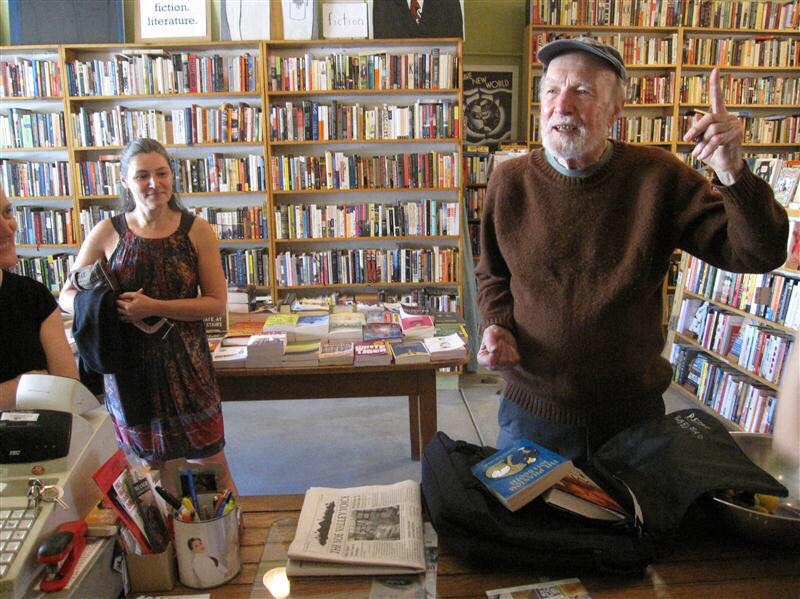
Pete Seeger was staying at Carmen’s in Noe Valley. And we at her local used bookstore sold not only books, but music too, and played American Roots Music all day long; the owner used to routinely hand me a check to go over to Down Home Music and buy all the latest reissues of Cajun and Bluegrass and Stringband Old Timey and New Orleans Trad Jazz- we’d play that music constantly. So as a surprise to me Carmen actually sneaked Pete Seeger in the door when I was shelving books in back.
She had to have told him to sneak up on me because there’s no way he would have wandered back there himself.
I’m laughing as I write this!
I looked up from shelving and saw this very familiar tall skinny man, with grizzled beard and a cap, just standing a few feet away. It was Pete Seeger.
So of course I hurried away. I didn’t want to blow his cover or disturb him!
I went to my coworker and whispered “I think that’s PETE SEEGER!”
Carmen was standing at a distance smiling- there she is in the photo you see- and introduced us.
Mr Seeger came to the counter and just regaled us with stories, as he would with any audience, large or small.
Now I’m crying as I write this. Get it together, dude!
He had in his little backpack a galley version of an anthology of songs and stories that had not yet been released. He showed us his life’s work in book form.
So I asked whether “The Lion Sleeps Tonight” was in there. Stupid, I know!
He opened to that page and we had to sing:
oweemawip oweemawip oweemawip
oweemawip oweemawip oweemawip
it was so funny!- you tube that song if you don’t know it. We always heard it when we were young.
Mr Seeger told us that he had just walked to the great, high fire lookout ‘way atop Mt Tamalpais, a place steeped in memory, where he could look down through the clouds and fog at the wonder of it all, the eternal beauty of the San Francisco Bay Area.
He was around 90 years old, I suppose. He had a lot of energy!
I remember thinking, this is just like meeting Walt Whitman- one of the greatest people of the entire century. And he was so real and unadorned and easy to be with and authoritative too. He sounded just like himself in his live recordings: cultivated, yet simple and clear, soft spoken, and slightly didactic. Always ready to entertain and inform. The very essence of the scholarly folk tradition of the 1950s and sixties.
And I thought, this is one person that stood up to the whole US government. When the government was insane and repressive, blacklisting the communists and “subversives” (when was it not?) he stood fast -he was steadfast. That skinny whisp of an individual held his ground.
They tried to destroy him and people like him. They tried, and failed.
He is Ike the suffragettes and the writers and Thoreau and Freedom Riders and labor activists and AIDS activists and many more we have to remember now.
Sing out, Pete Seeger. You wrote the book. We can turn the page.
So that was the surprise for me at our little bookstore one day.
We need to think about Pete and Woody now, the songbook and the true national anthem: this land IS your land! This land IS my land. And the people that come here – it’s their land too. It was made for you and me.
“We will not be moved.” Or will we?
How does that old song go- the one about organizing? And saving the river.
There’s the fog. Can’t see the mountain from here. But listen to this:
“When the sun came shining, and I was strolling,
And the wheat fields waving and the dust clouds rolling,
As the fog was lifting a voice was chanting:
This land was made for you and me.
As I went walking I saw a sign there
And on the sign it said ‘No Trespassing’
But on the other side it didn’t say nothing,
That side was made for you and me.”
– that’s the lost verse, not often sung.
jk
10/4/18
(support your local bookstore)
https://www.woodyguthrie.org/Lyrics/This_Land.htmhttps://www.youtube.com/embed/Y0_IME9WsHQ?version=3&rel=1&fs=1&autohide=2&showsearch=0&showinfo=1&iv_load_policy=1&wmode=transparent
below, from Noe Valley Voice, October, 2009, photo and caption:
***
I met a Beatle!


Decades ago Phoenix Books and Records used to display rare LPs behind the counter and a man who looked quite like George Harrison came in one day back in the eighties and whispered to me that he worked at Abbey Road and pointed at an early Beatles record and shook his head. He told me ”he was there.” He did not want to draw attention in the busy store or tell me more. He was just stunned to see that record. I never figured out who I met, though I often thought about it. I
He was Norman Smith, the Beatles first recording engineer. He sounded just like them too! A quiet, laconic British gent. Like Liverpool. Very George. He was the recording engineer on all the early records. It was as if he was telling me a secret. He was very humble and soft spoken. And obviously moved to see that record.
I’m almost positive that “Beatles For Sale” (1964) was the record that the early Beatles recording engineer spotted at our record store- which is great, because it’s the record my sister got for Christmas that year in its alternate US release as “Beatles ‘65” so was our first and only Beatle album. It has George Harrison’s homage to Carl Perkins, “Honey Don’t” and Lennon’s “No Reply”. “I’ll Follow the Sun”- So perhaps the first Beatles record becomes your favorite Beatles record.
It seems likely that the record expert at the bookstore saw that this early Lp was not released in the US and so was worthy of display behind the counter.
Nice Christmas present, lads.
My sister got “Beatles ‘65” for Christmas from our cool uncle who must have picked it up just before, since it was released in November. It was our first listen to rock and roll at home.
It’s weird to explain 50 years later to a new generation of listeners why a Beatles record would mean so much-but it does.
This early record sounds unlike any other Beatle album. Harrison’s guitar is prominent- and one tune even leads with extended feedback. There’s a bit of rockabilly and the ballads are very unadorned with a live, roomy sound to them. And Beatles’ strangely modal music- Who writes like that?
It features that insane Latin tinge piano accompaniment to John Lennon’s cover of “Rock and Roll Music” that we learn was played by George Martin. And listen to Ringo come in late to “I Feel Fine” with the cymbals. Still totally thrilling!
The recording engineer, Norman Smith, worked with George Martin on the first four Beatles albums- so that day years ago at the bookstore I met the man who recorded our beloved LP. And the other hundred Beatles singles we grew up listening to.https://www.youtube.com/embed/WrAV5EVI4tU?version=3&rel=1&fs=1&autohide=2&showsearch=0&showinfo=1&iv_load_policy=1&wmode=transparenthttps://www.youtube.com/embed/RLAK8o0RXtA?version=3&rel=1&fs=1&autohide=2&showsearch=0&showinfo=1&iv_load_policy=1&wmode=transparent
***
Troubadour Bruce Sherman 1943- 2009
by jk noe valley voice

Musician Bruce Sherman passed away on Aug. 9, 2009. Many know him as the kind gentleman who played the accordion and concertina at Phoenix Books on weekend evenings. Others will remember earlier years when Bruce frequented the old Meat Market Coffeehouse, and more recently Martha’s, where they would have enjoyed his earnest manner, wry sense of humor, his graciousness and courtesy.Bruce will be missed by many people in many communities. A fourth-generation San Franciscan whose happiest years were spent in Noe Valley, he was devoted to local history and lore. Bruce loved to regale all comers with tales of the past. His German-speaking grandparents lived at 30th and Church. Bruce said English was a second language in the household in what was then a German neighborhood.
Bruce was born on April 18, 1943. He was proud to share his birthday with the annual commemoration of the Great San Francisco Earthquake and Fire of 1906. Every year at 5 a.m., Mr. Sherman would be at Lotta’s Fountain for the ringing of the bell at the moment of the quake. He laughed that one year he did feel a little temblor–not the Big One, of course.
Though Bruce was born in San Francisco in the neighborhood near Lake Merced, his family moved to San Carlos down the Peninsula when he was 5. His mother joked that Bruce never quite got over leaving San Francisco, and when he eventually found his way back to the city, he came to stay for good.
Bruce served in the Army Signal Corps, stationed in Germany in the early 1960s. He and a fellow soldier there became buskers–spontaneous street musicians–to pass the time. His love of music developed into an avocation which he shared with others for the rest of his life. He was part of a major movement in American roots music in which every source of live or recorded music, from every part of the world, became part of the American songbag.
As a self-made folk scholar, Bruce collected songs from recordings and from the performances of others for decades. By the end of his life, he had a songster’s mastery of many forms of Anglo/Irish/French dance tunes, which even included the archaic English morris dance. A natural teacher, he presented his tunes with introductions and background stories.
His primary vocation was as a craftsman, however. He became skilled at cabinetry and design, using innovative techniques of framing glass and wood. Upon his return to San Francisco, Bruce had become acquainted with the prominent artist/sculptor Ruth Asawa and her husband, architect Albert Lanier, residents of Noe Valley. “They took Bruce under their wing,” Bruce’s mother explained to this writer.
Through them, Bruce found work at Hoffer Glass Company south of Market. Bruce’s window-framing work was sculptural, in that it involved many-faceted shapes, with deceptively simple-looking hexagonal or octagonal features. A culmination of this work was his scale-model of R. Buckminster Fuller’s geodesic dome. Bruce met Fuller at Ruth Asawa’s, and the meeting was a high point of his life.
There is lasting evidence of Bruce Sherman’s personal history, at the de Young Museum in Golden Gate Park. There, one will find his name on a plaque at the permanent exhibit of Ruth Asawa’s sculpture, an acknowledgment of his contribution to one of her pieces. A rare honor, he told his friends–and yet, in his own characteristic way, a quiet understatement of his own unique talent.
Bruce Sherman’s deepest interest seemed to be in the history of San Francisco. He was devoted to its many causes, and was an avid appreciator of its technical glories–especially the cable cars and ferry lines, the steam-driven railroads, and the city’s unique maritime history. He had a special expertise in San Francisco maps, going back to the earliest days. Accurate maps were a key to the world of the city in every era, he said, and he appreciated them as a true art form.
Most recently Bruce devoted his time to perfecting his musical craft. He performed on button accordion and concertina weekly at the Hyde Street Pier, aboard the historic ship Balclutha, and played a variety of instruments in a variety of ensembles, sometimes at the Cafe Trieste in North Beach, or in sessions at other cafes around the city, and finally at Phoenix Books where he seemed most at home. The unexpected pleasure of live music, without fuss (or amplification), was Bruce’s ideal. People responded with a smile, assuming that the next time they’d stop by, he’d be there.
Bruce Sherman would always end the evening with this lovely Irish tune:
The Parting Glass
O, all the money e’er I had,
I spent it in good company.
And all the harm that e’er I’ve done,
Alas it was to none but me.
And all I’ve done for want of wit
To mem’ry now I can’t recall;
So fill to me the parting glass,
Good night and joy be with you all.
O, all the comrades e’er I had,
They’re sorry for my going away.
And all the sweethearts e’er I had,
They’d wished me one more day to stay.
But since it falls unto my lot,
That I should rise and you should not,
I gently rise and softly call,
http://www.noevalleyvoice.com/2009/September/Bruc.htm
https://www.sfgate.com/news/article/Sad-farewell-to-musician-Bruce-Sherman-3287791.php
***
Woodstock, Side Two.
The Woodstock broadcast ”Woodstock as it Happened” on WXPN was so unexpectedly powerful.
Fifty years ago: the Three Days of Peace and Music!
…to relive memories of a time when music radio and recorded sound had a much, much different impact and influence than today, unexpectedly profound. It was so much fun to hear it all.
That’s how most of us heard Woodstock originally, six long playing records broadcast and simulcast with film.
Did it matter that this weekend the hundred hours of music and announcements were broadcast in real time?
Yes.
Back when all-night FM radio was a form of free expression, music could take you somewhere. It could evolve over hours.
The 1960s was the original mixed tape! The mother of all playlists, in its first abstract expressive form.
FM DJs would say: Tonight we are going to play the whole side without interruption.
And AM radio in the sixties was an amazing mix: of Motown and British Invasion and pop tunes and Aretha Franklin and pre/psychedelia. Inagaddadavida, baby.
Culturally available, a mass audience, but a shared experience.
Of course, the counterculture of the sixties actually WAS the culture and was forever bumping hard against tragedy all the time. Assassination, war, real government conspiracies, Kent State.
Music and radio smashed racial boundaries and so did the war and so did the peace movement.
The Hippies were pretty conservative, especially along gender lines, so that was weird.
But the counterculture fed the poor and invented free clinics and CoEvolution Quarterly bid you to bake your own bread and plant a raised bed and frame your own yurt and go out to the country and be part of the solution.
There was Alan Watts introducing us to Zen and Firesign Theatre to the weird psyche of USA and Woody Guthrie and Pete Seeger holding the government to account.
Thank God for the Million Women’s March of 2016- that’s an indication of the Woodstock promise of an earlier time. The one million became five or ten million, world wide. And may save us yet from the totalitarianism which has loomed since 1947.
And this President today? A complete establishment square. The Man. An object of complete loathing. Gimme an F. Gimme a U. Gimme a C. Gimme a K. What’s that spell?
In this particular context the “conservative movement” is an absolute horror. It has no guts, no body, no soul, no music. It’s the Dark Shadows of our Puritan past. A forever rerun of inauthenticity.
But at Woodstock there was a fantastic, perfect example of authenticity in the performance of American music.
For example, The Band.
I didn’t even know they were at Woodstock! They lived there, but who knew?
Why wasn’t The Band in the movie, I wonder.
I know why the Dead was cut- but I completely enjoyed their set. And I loved the congruence between the Dead and Janis and Jefferson Airplane and CSN- I completely get it.
The Dead Jefferson Creedence Crosby Janis Santana Tuna Revival – the West Coast- crushed it at Woodstock!
I miss my friend Master Sgt. Johnny Trudeau, the Vietnam War veteran. He would’ve loved this. Woodstock meant more to him, a veteran of foreign wars, than to us kids safe at home. I hope he’s ok wherever he is.
Back from Vietnam, and years later, Army Ranger Johnny collected all that music vinyl from the Woodstock years and from his time growing up in San Francisco. It was giving him something back that nothing else could.
From the Haight to Vietnam and Woodstock and back. What we thought as psychedelia, he saw as sanity.
Myself, I’m in my own sixties, and last night fell asleep to “Woodstock Live as it Happened”, broadcast on WMPX Philadelphia. I think I dozed off at the end of Johnny Winter after midnight-of all performances, certainly the least soporific.
I awakened to hear Neil Young’s “Mr Soul” backed by a spare guitar chord that tolled like a bell. The Holy Grail of Woodstock has to be that one.
Turn the record over man. Let’s hear side two. And three.
And four five six :what’r we fightin for?
 jameskoehnsf's Blog