Remembering David Crosby.
The Posse
Or, 13 Views of If I Could Only Remember My Name.
- There’s an entire room in my psyche devoted to the Remember My Name Sessions, David Crosby’s 1970 solo collaboration with -everyone.
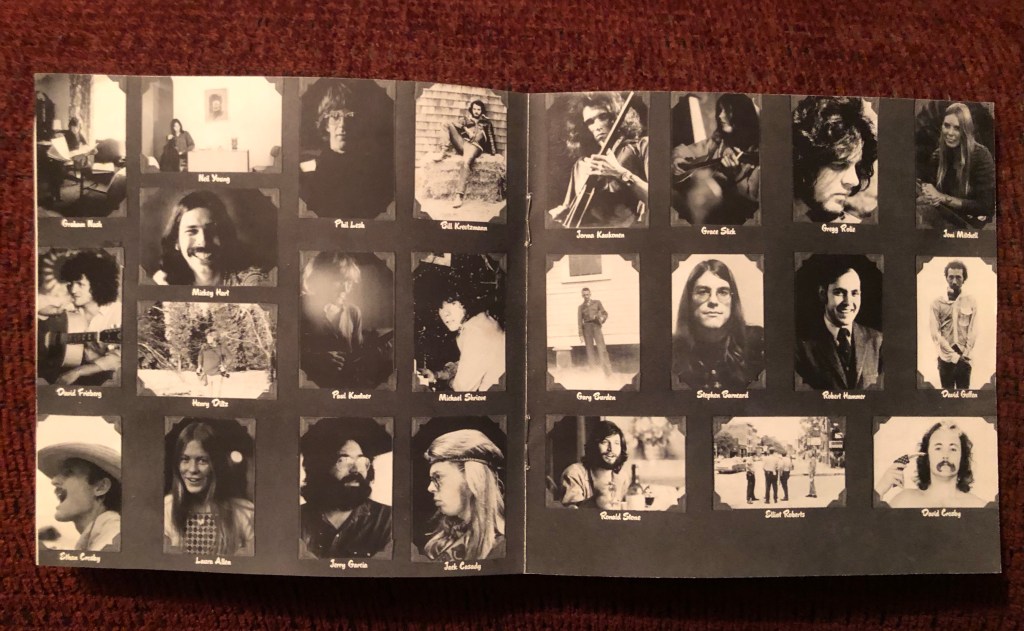
- Everyone is there. David, Jerry, Neil, Paul Kantner. Rita Coolidge. Captain Manyhands. Graham. The Deja Vus. Mr Barnhard. Joni. John B Sebastian. Everyone. (People that were never there, are there, too.) But Jorma. Grace. Jack. They’re there. Jackson Brown and his gang of Eagles, Desperados. Playing dead on Main St, in a false front western ghost town.
- It’s The California Posse. A round- up for daguerreotype. They all rode in together, making tremendous clouds of dust and the dust is gold and the saloon door’s open and everyone is high and-
- did you hear Jerry Garcia’s impromptu pedal steel, stratospheric, nuanced, perfect sublime? Laughing. In the sun.
- Did you hear John B Sebastian, filling in a spare, pure, resonant four measures of harmonica, on “Deja Vu” bringing it home? He’s there. It takes everything to perform three sliding notes in the right place at the right time.
- There’s a lot of lift and nuance in those solos. These are pinnacle moments. These are what people take drugs to achieve. High points. Peak experience. To me, these sessions are the unmistakable sublime.
- Jack Cassady’s ground-of being bass thrumming, vibrating the floor boards. Neil Young’s “Music is Love” backing vocal, straight out of the old hearse and wide across Mill Valley, and the gorgeous reverberation trailing from it.
- Joni and David singing like angels on a Saturday night, in high spirals, effortlessly inventing every moment.
- This is the California sound. We own it. I can see Mt Tam from my window. I see it every day. The album must be seen in context, and the context is me. Inside me.
- So those sessions are ongoing. I can drop in whenever I feel like it. It’s always the middle of the night, the wee hours, when late night radio jocks put a needle in the groove and go for a smoke and it’s just you and this hippie jam thang, with the Crosby/Nash/Jefferson/Dead/ Band of Eagles.
- Joni reminds us they INVENTED this work. The “singer/ songwriter” didn’t exist before. The songwriter/performers, solo-in-society. Newly minted. Stamped, certified authenticity.
- David Crosby. His pals. They developed what had never been heard before, nor had even ever been thought of.
- Who knew 12-string guitars shimmer? Who knew that hand-claps are of equal importance?- they resonate; you hear the room. You can hear the acoustics of the space. It’s so real! Wooden Music, they called it. And Gold Rush. And Canyon. And the Haight. The Haight Fricking Ashbury. When the Beatles got famous- they came here.
Music is love. Oh fuck I’m grieving.
So David, I know where paradise is. You are there.
***
Love me some sepia- toned folkology.
Grateful I grew up in an era with a booming music tradition of traditional music living room hoe down and Irish pub, with a hammering dulcimer and fiddles and whatnot nearly every night of the week.
Music documentaries are the only thing I watch anymore and I’m more likely to play a Beatles tune or a Jackson Browne or a Neil Young tune myself than to play a record. And that brings it full circle. That’s my folk music really.
Beatles are almost folk tunes now. They are so great so folded into culture that even an amateur can rock the shit out of Eight Days A Week or Ticket to Ride right out of the book.
But these come out of the dark cauldron of the folk music and art school weirdness of an earlier era. Old Modes. Church modes. And modes more remote still.
The British Folk are in a zone of their own, and many contended for non-invasive folksiness to no avail. Established Tradition and scorned innovation. Unlimited, within certain limitations.
From beatniks and bongo drums to advanced musicology, most research came from scratchy vinyl borrowed from the public library on the hill by the water tower across the street from the cemetery where the town dignitaries are buried; two hundred years ago they heard some of these airs sung without amplification.
I borrowed the Harry Smith Anthology of Folk Music with that astounding book of notes and its multiple records and loved the Cajun fiddle tune and “Old Blue” and I learned one tune (“Cindy”) on the banjo bought for $60 from Gary Peacock’s musical instrument shop across from Cafe Flor where all the stringband musicians hung out. Straggly- haired post-hippie hangout in the seventies.
I played that thing on the back porch in the Haight, using Pete Seeger’s “How to Play the 5-string Banjo” book. A treasure.
My theory is that my sixties pop composers have launched their pieces into eventual half- remembered folk music as well.
The melodies aboard the Voyager spacecraft are far beyond our heliosphere now. Some far-out being, light-years away, will reverse engineer a Woody Guthrie tune and unlock a key to what, exactly?
Who knows?
Some trite old thing pulled up from the deep well of my being.
The tunes are immortal. That’s what will last. Nothing is ever lost really.
Music making is pre-TV. It’s Neanderthal. It’s the old ways.
The books are written and the music is out there more than ever, the Home Version.
Yes, sometimes you work on a thing for hours and hours and hours. That’s great, too.
These artists were virtuosos in their realm.
I do love that people gathered to learn and cheat and steal and make mistakes. I saw that in the seventies in living rooms etc. – Classical traditions are way too perfectionistic. You need to wail sometimes. Fuck that shit up and then await the perfection of an afternoon when you play it good. It’ll sound like you.
Donovan is a god! True.
 jameskoehnsf's Blog